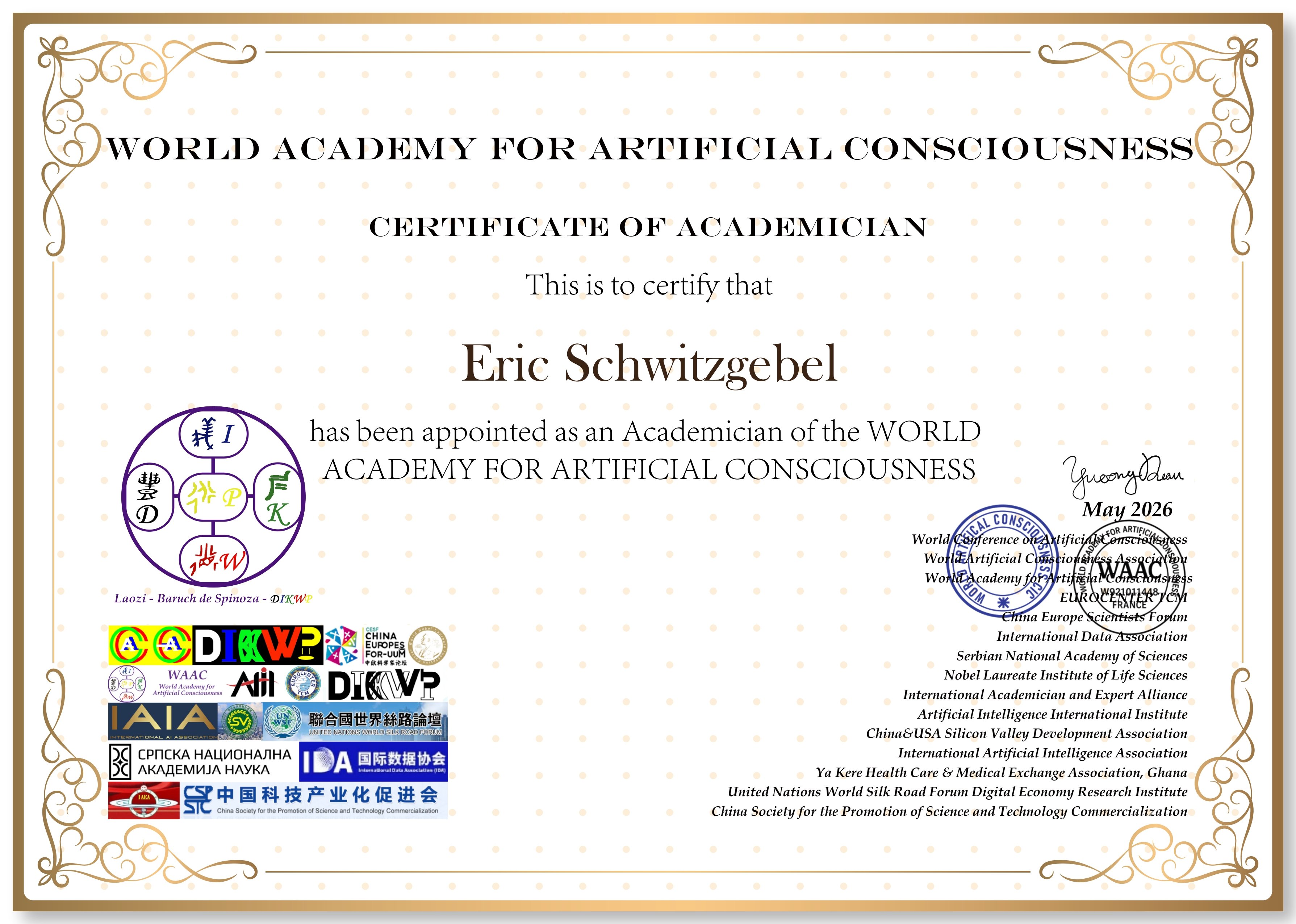
We are pleased to announce that Eric Schwitzgebel, a renowned American philosopher and Professor of Philosophy at the University of California, Riverside, has been elected as an Academician of the World Academy of Artificial Consciousness (WAAC), in recognition of his sustained scholarly contributions to philosophy of mind, consciousness studies, epistemology of introspection, moral psychology, artificial intelligence consciousness, robot rights, and the moral status of artificial intelligence.
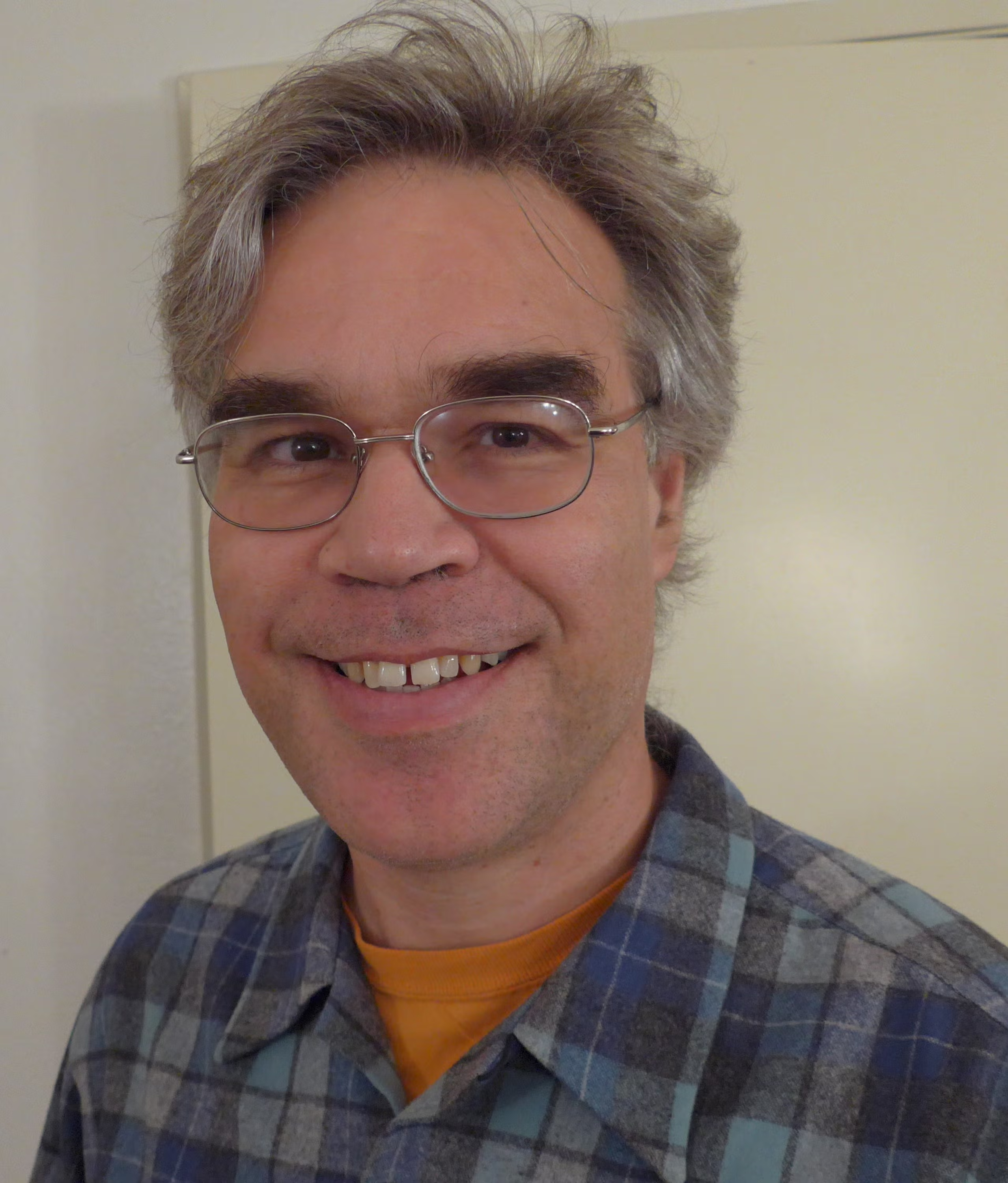
Professor Schwitzgebel has long been dedicated to foundational research on conscious experience, the reliability of introspection, the structure of belief, moral psychology, and AI ethics. On the one hand, his work deeply examines the cognitive limitations of human beings in understanding their own conscious experience; on the other hand, it connects philosophy of mind and consciousness science with frontier issues in the development of artificial intelligence. His research systematically explores whether machines could possess consciousness, whether future AI systems might have moral status, and how human society should avoid misjudgments concerning AI systems’ sentience, agency, and moral identity.
Professor Schwitzgebel has had broad influence in the philosophy of consciousness. In Perplexities of Consciousness, he systematically discusses subjective experience in relation to dreams, mental imagery, emotion, and visual experience, arguing that human knowledge of its own stream of consciousness is far less reliable than commonly assumed. In Describing Inner Experience? Proponent Meets Skeptic, co-authored with Russell T. Hurlburt, he engages in an interdisciplinary discussion of introspective reports, experience sampling, and the reliability of descriptions of conscious experience. In The Weirdness of the World, he further examines the deep uncertainties and theoretical limits encountered by human reason when confronting the basic structure of the world, from the perspectives of consciousness, metaphysics, cosmology, and the future moral status of artificial intelligence.
In the fields of artificial consciousness and AI ethics, Professor Schwitzgebel’s work is of particular contemporary significance. In “A Defense of the Rights of Artificial Intelligences,” co-authored with Mara Garza, he discusses whether artificial intelligence systems should receive corresponding moral consideration and rights protection if they possess no morally relevant differences from human beings. In his 2023 article “AI Systems Must Not Confuse Users about Their Sentience or Moral Status,” published in Patterns, he further argues that the design of AI systems should not lead users to misjudge whether such systems have sentience or moral status. Instead, the interface and interaction patterns of AI systems should, as far as possible, correspond to their actual moral status, so as to avoid ethical confusion and social risks caused by systems that appear conscious or whose moral identity is unclear.
WAAC believes that the future development of artificial consciousness depends not only on computational models, intelligent algorithms, and engineering architectures, but also on profound philosophical reflection on consciousness, subjective experience, moral status, human–machine relations, and social responsibility. Starting from the uncertainty of human introspection and extending to machine consciousness, robot rights, AI moral identity, and the governance of future intelligent systems, Professor Schwitzgebel’s research provides important philosophical foundations, ethical frameworks, and problem awareness for the study of artificial consciousness.
In recognition of Professor Eric Schwitzgebel’s outstanding contributions to philosophy of mind, consciousness studies, moral psychology, AI consciousness ethics, and the moral governance of future intelligent systems, the World Academy of Artificial Consciousness has decided to confer upon him the title of WAAC Academician. WAAC looks forward to further promoting cross-disciplinary exchange among artificial consciousness, consciousness science, philosophy of mind, AI ethics governance, and the construction of trustworthy artificial intelligence systems, and to jointly exploring new pathways through which advanced intelligent systems can serve human cognition, social well-being, and the future development of civilization.
- Global Collaboration and Academic Ecosystem
Academicians of the World Academy of Artificial Consciousness hail from institutions such as Harvard University, the Massachusetts Institute of Technology, the University of Cambridge, the University of California, the French Academy of Sciences, the University of Padua, the University of Oxford, the University of Queensland, Columbia University, and the University of Exeter. Honorary Academicians come from a wide range of countries and regions, including the United States, the United Kingdom, France, Germany, Italy, Sweden, Canada, Australia, Spain, and China. In addition, leading scientists from prominent research institutes and technology companies—such as Google, the Allen Institute for Brain Science, and ZEEKR—also participate.
- About WAAC
The World Academy of Artificial Consciousness (https://www.waac.ac/) is a global academic institution established in Paris in 2025. Its mission is to advance frontier research and international collaboration in artificial consciousness through the integration of science, technology, and philosophy. The Academy publishes open research, policy recommendations, evaluation standards, and more. The current President is Academician Yucong Duan, and the Secretary-General is Dr. Yingbo Li. The Honorary Academician List: On May 3, 2025, WAAC released its first batch of Top 100 Honorary Academicians, recognizing scholars who have made foundational or leading contributions to the theory of artificial consciousness.