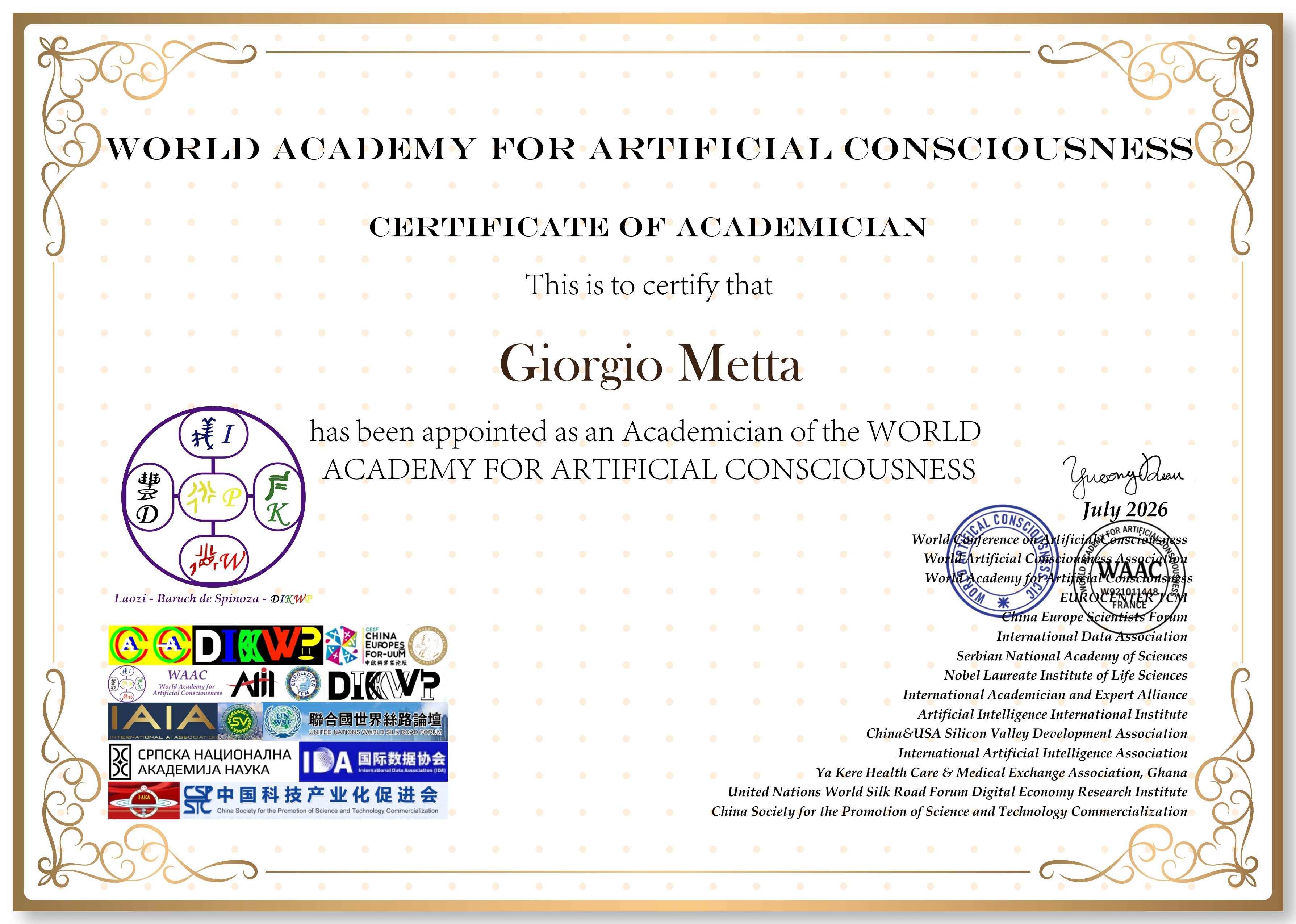
We are pleased to announce that Professor Giorgio Metta, Scientific Director of the Istituto Italiano di Tecnologia (IIT) and an internationally renowned roboticist, has been elected as an Academician of the World Academy of Artificial Consciousness (WAAC) in recognition of his important contributions to humanoid robotics, embodied artificial intelligence, cognitive robotics, bio-inspired systems, robot learning, sensorimotor intelligence, tactile perception, human–robot interaction, Physical AI, and embodied cognitive systems related to artificial consciousness.
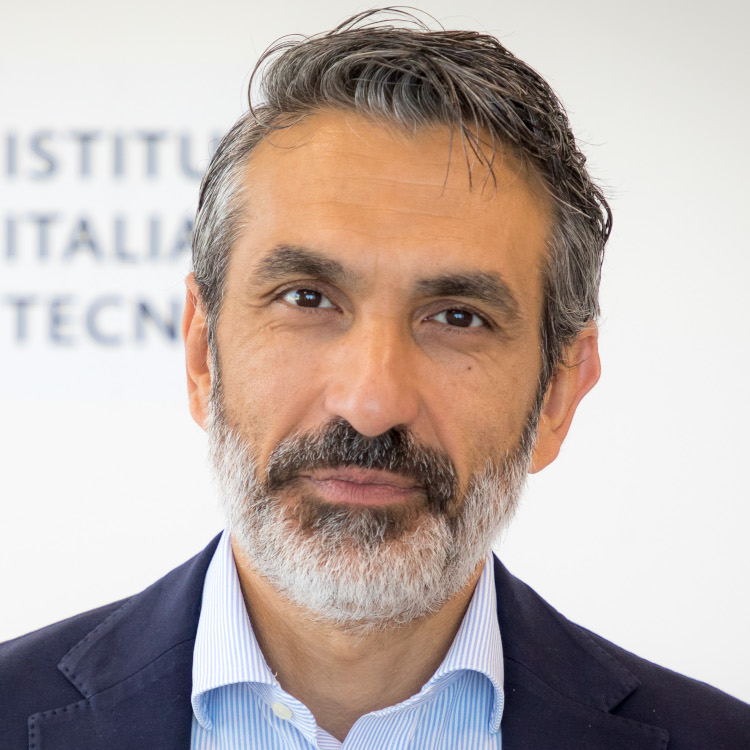
Professor Giorgio Metta is an internationally influential scholar in humanoid robotics, embodied artificial intelligence, and cognitive robotics. His research focuses on how intelligent machines develop cognitive and adaptive capabilities through bodily structures, sensorimotor experience, environmental interaction, and continuous learning. He has made important contributions to bio-inspired robotics, tactile perception, artificial skin, robot learning, and human–robot collaboration, providing significant theoretical and technological foundations for the development of artificial agents capable of learning, acting, adapting, and safely collaborating with humans in real-world environments.
As Scientific Director of the Istituto Italiano di Tecnologia, Professor Metta continues to promote interdisciplinary integration among robotics, artificial intelligence, cognitive science, neuroscience, and engineering. He graduated from the University of Genoa, conducted postdoctoral research at the Artificial Intelligence Laboratory of the Massachusetts Institute of Technology, and previously served as Professor of Cognitive Robotics at the University of Plymouth. Professor Metta has published more than 300 academic papers, led or participated in numerous international research projects, and has played a long-standing leadership role in the development of the iCub humanoid robot.
Under his leadership, iCub has become an important international experimental platform for research in cognitive developmental robotics, embodied intelligence, and human–robot interaction. It has also supported the development of new humanoid robotic systems such as ergoCub and iRonCub. This body of research has advanced whole-body perception, tactile interaction, motion control, autonomous learning, and industrial collaboration, while also helping embodied artificial intelligence and Physical AI move from laboratory research toward practical applications.
WAAC believes that research on artificial consciousness requires deeper investigation into how intelligent systems develop cognitive abilities and consciousness-like mechanisms through embodiment, perception, action, learning, and social interaction. Professor Metta’s work in humanoid robotics, embodied cognition, sensorimotor learning, body representation, tactile perception, and human–robot interaction provides an important experimental foundation for studying perception–action loops, agent autonomy, continuous learning, and the relationship between the self and the environment.
In recognition of his outstanding contributions to humanoid robotics, embodied artificial intelligence, cognitive robotics, robot learning, tactile perception, human–robot interaction, and embodied cognitive systems related to artificial consciousness, the World Academy of Artificial Consciousness has decided to confer upon Professor Giorgio Metta the title of WAAC Academician.
- Global Collaboration and Academic Ecosystem
WAAC Academicians come from world-leading universities, national academy systems, and frontier research institutions, including Harvard University, the Massachusetts Institute of Technology, the University of Cambridge, the University of Oxford, the University of California, Columbia University, Princeton University, the University of Chicago, University College London, the University of Padua, the University of Queensland, the University of Exeter, the French Academy of Sciences, the German National Academy of Sciences, the U.S. National Academy of Sciences, the U.S. National Academy of Engineering, the Chinese Academy of Engineering, the Royal Society, the Allen Institute for Brain Science, and the Max Planck Institute. The body of Academicians includes multiple Nobel Prize laureates, Turing Award laureates, members of national academies of sciences and engineering, Fellows of the Royal Society, and Fellows of internationally important academic organizations such as IEEE, AAAI, AAAS, and the British Academy. By bringing together leading scholars in natural consciousness research, machine consciousness modeling, brain science mechanisms, cognitive robotics, deep learning, brain-computer interfaces, and AI governance, WAAC has built an artificial consciousness research ecosystem that combines scientific depth, technological frontier orientation, philosophical insight, and global collaborative capacity, demonstrating its academic foundation and international influence in the emerging field of artificial consciousness science.
- About WAAC
The World Academy for Artificial Consciousness (https://www.waac.ac/) is a global academic institution established in Paris in 2025. Its mission is to advance frontier research and international collaboration in artificial consciousness through the integration of science, technology, and philosophy. The Academy publishes open research, policy recommendations, evaluation standards, and more. The current President is Academician Yucong Duan, and the Secretary-General is Dr. Yingbo Li. The Honorary Academician List: On May 3, 2025, WAAC released its first batch of Top 100 Honorary Academicians, recognizing scholars who have made foundational or leading contributions to the theory of artificial consciousness.