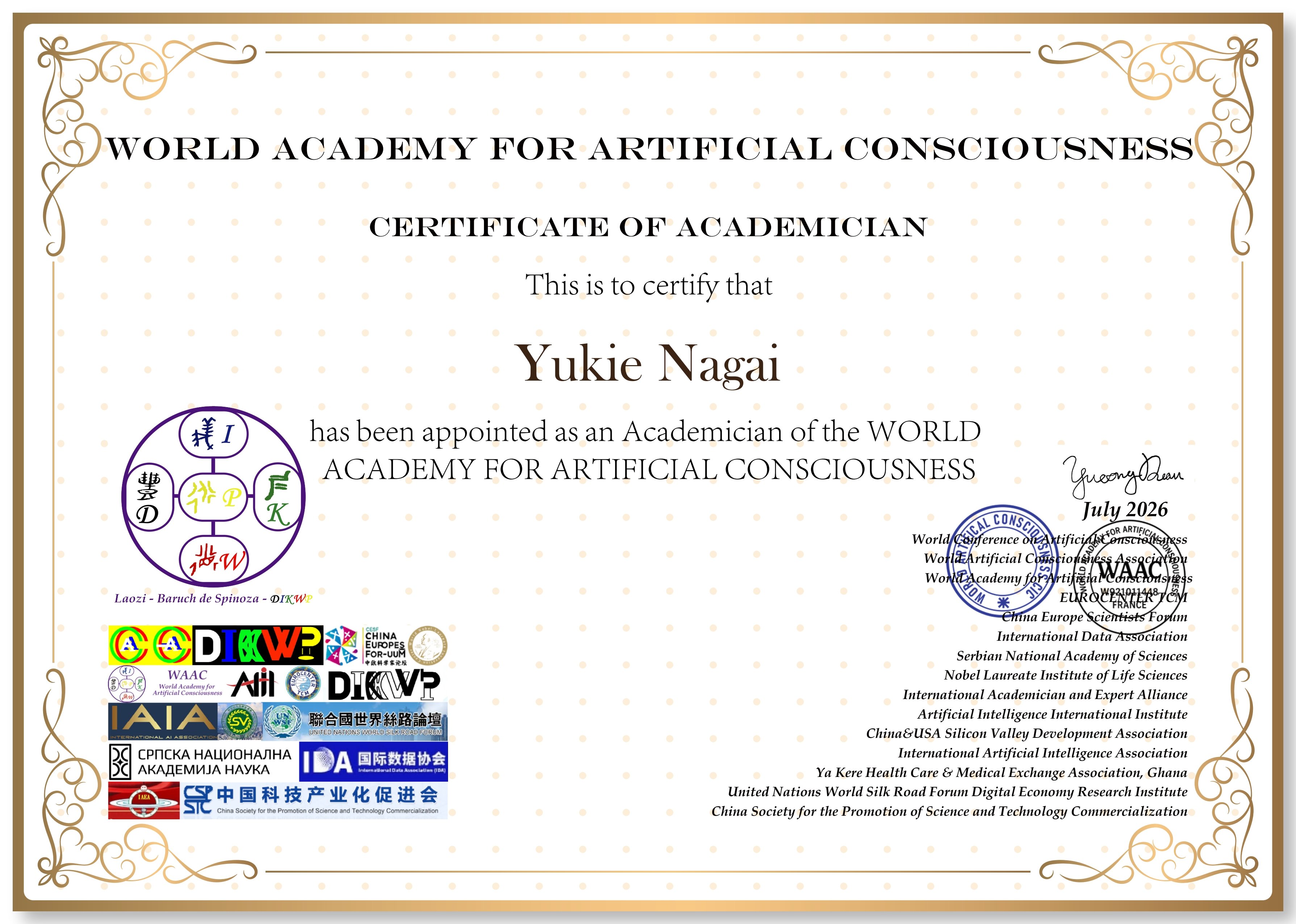
We are pleased to announce that Professor Yukie Nagai, Project Professor at the International Research Center for Neurointelligence (IRCN), The University of Tokyo, Japan, and Director of the Cognitive Developmental Robotics Lab, has been elected as an Academician of the World Academy of Artificial Consciousness (WAAC), in recognition of her important contributions to cognitive developmental robotics, computational neuroscience, predictive processing, embodied predictive learning, social cognitive development, neural network modeling, human–robot interaction, assistive technologies for developmental disorders, neurodiversity, affective cognition, and cognitive developmental models related to machine consciousness.

Professor Yukie Nagai is a distinguished scholar with international influence in the fields of cognitive developmental robotics, computational neuroscience, and robotic cognitive development. She has long been devoted to studying how human cognitive abilities gradually emerge through the body, environment, sensorimotor experience, and social interaction. Through artificial intelligence, neural networks, predictive processing models, humanoid robots, and computational experimental methods, she has explored the mechanisms underlying infant cognitive development, social cognition, self–other cognition, emotion understanding, joint attention, behavioral synchronization, and individual differences. Her work has systematically advanced the development of cognitive developmental robotics, embodied predictive processing, robotic social cognition, computational modeling of developmental disorders, understanding of neurodiversity, and assistive technologies. Her research has not only deepened our understanding of the relationships among perception, action, prediction, emotion, social interaction, and cognitive development, but has also provided important theoretical and methodological foundations for building artificial agents capable of developing cognitive abilities through continuous learning, social interaction, and embodied experience. As Project Professor at the International Research Center for Neurointelligence of The University of Tokyo and Director of the Cognitive Developmental Robotics Lab, Professor Nagai has continuously promoted interdisciplinary research across artificial intelligence, robotics, cognitive science, neuroscience, developmental psychology, and assistive technologies, and has led major JST CREST projects including “Cognitive Mirroring” and “Cognitive Feeling.” She has been selected among Analytics Insight’s “World’s 50 Most Renowned Women in Robotics,” IEEE IROS’s “35 Women in Robotics Engineering and Science,” and Forbes JAPAN’s “Women in Tech 30,” and has served as an IEEE RAS Distinguished Lecturer, making outstanding contributions to the global development of cognitive developmental robotics, computational neuroscience, social cognitive modeling, and human–robot interaction.
WAAC believes that research on artificial consciousness requires not only advances in artificial intelligence, cognitive science, neuroscience, computational models, and philosophical theory, but also a deeper understanding of how intelligent systems form cognitive abilities and consciousness-like behavioral mechanisms through embodied experience, predictive learning, social interaction, affective perception, self–other distinction, continuous development, and environmental adaptation. Professor Nagai’s work on cognitive developmental robotics, predictive processing, embodied cognition, social cognitive development, affective cognition, neural network modeling, humanoid robot experiments, and assistive technologies for developmental disorders provides important theoretical resources and methodological support for modeling cognitive developmental mechanisms, perception–action loops, self and other representation, the construction of social agents, the integration of emotion and sensation, understanding neurodiversity, machine cognitive growth pathways, and the consciousness-like developmental capabilities of future artificial agents in the study of artificial consciousness. Her research path, spanning artificial intelligence, robotics, computational neuroscience, developmental psychology, social cognition, and assistive technologies, offers important inspiration for connecting human cognitive developmental mechanisms, embodied intelligence, social agents, and the construction of artificial consciousness systems.
In recognition of her outstanding contributions to cognitive developmental robotics, computational neuroscience, predictive processing, embodied predictive learning, social cognitive development, affective cognition, human–robot interaction, assistive technologies for developmental disorders, and cognitive developmental models related to artificial consciousness, the World Academy of Artificial Consciousness has decided to confer upon Professor Yukie Nagai the title of Academician of WAAC.
- Global Collaboration and Academic Ecosystem
WAAC Academicians come from world-leading universities, national academy systems, and frontier research institutions, including Harvard University, the Massachusetts Institute of Technology, the University of Cambridge, the University of Oxford, the University of California, Columbia University, Princeton University, the University of Chicago, University College London, the University of Padua, the University of Queensland, the University of Exeter, the French Academy of Sciences, the German National Academy of Sciences, the U.S. National Academy of Sciences, the U.S. National Academy of Engineering, the Chinese Academy of Engineering, the Royal Society, the Allen Institute for Brain Science, and the Max Planck Institute. The body of Academicians includes multiple Nobel Prize laureates, Turing Award laureates, members of national academies of sciences and engineering, Fellows of the Royal Society, and Fellows of internationally important academic organizations such as IEEE, AAAI, AAAS, and the British Academy. By bringing together leading scholars in natural consciousness research, machine consciousness modeling, brain science mechanisms, cognitive robotics, deep learning, brain-computer interfaces, and AI governance, WAAC has built an artificial consciousness research ecosystem that combines scientific depth, technological frontier orientation, philosophical insight, and global collaborative capacity, demonstrating its academic foundation and international influence in the emerging field of artificial consciousness science.
- About WAAC
The World Academy for Artificial Consciousness (https://www.waac.ac/) is a global academic institution established in Paris in 2025. Its mission is to advance frontier research and international collaboration in artificial consciousness through the integration of science, technology, and philosophy. The Academy publishes open research, policy recommendations, evaluation standards, and more. The current President is Academician Yucong Duan, and the Secretary-General is Dr. Yingbo Li. The Honorary Academician List: On May 3, 2025, WAAC released its first batch of Top 100 Honorary Academicians, recognizing scholars who have made foundational or leading contributions to the theory of artificial consciousness.